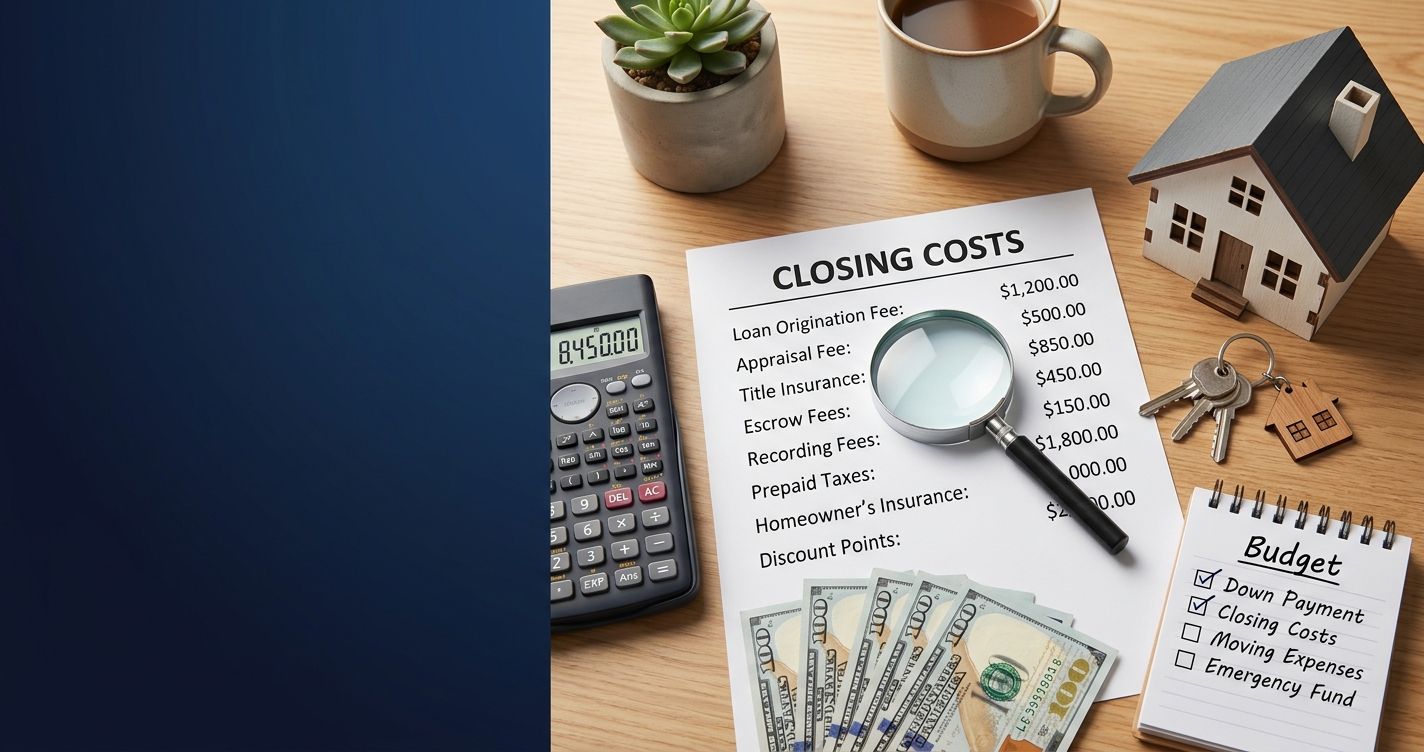
The purchase price is just the beginning. Every homebuyer knows they need a down payment. Most know there are closing costs. But the full list of expenses that show up between contract and move-in day catches people off guard every time, and in Texas, several of those costs are higher than the national average.
I'm Ben Eddy, a wholesale mortgage broker and the founder of Colt Lending (NMLS #2032978), powered by Edge Home Finance (NMLS #891464). I walk every buyer through the complete cost picture before they start shopping, because nothing kills the excitement of homeownership faster than a surprise bill you didn't budget for.
Here's everything that actually costs money when you buy a home in Texas, broken down so you can plan for all of it.
What "Closing Costs" Actually Means (And Why the Label Is Misleading)
Most people hear "closing costs" and think of it as one big fee. It's not. What shows up on your Loan Estimate and Closing Disclosure is actually three distinct categories of expenses, and understanding the difference matters because each one works differently.
Lender costs are the fees your mortgage lender charges for underwriting and processing the loan. In the wholesale channel, these are typically called underwriting fees or lender fees rather than "loan origination fees" (that's more of a retail banking term). My lenders typically charge $795 to $1,500 for this. It's usually the smallest portion of your total closing costs.
Third-party costs are fees paid to outside parties involved in the transaction: the appraiser, the title company, the surveyor, the credit reporting agency, and others. These are not controlled by your lender or your broker. They're set by the companies providing the service.
Escrow collections are prepaid property taxes, homeowners insurance, and prepaid interest. These aren't fees at all. They're expenses you'd be paying regardless of whether you were buying a home or not. They're just collected upfront at closing and held in an escrow account. I'll break these out separately in the next section.
People tend to see the total on their Closing Disclosure and assume they're being charged thousands in "fees" when the reality is that the lender's actual fees are a relatively small piece. The bulk of what gets labeled "closing costs" is third-party services and escrow collections.
Here's what makes up the third-party costs:
Appraisal fee. The lender requires an independent appraisal to confirm the home's value before they'll fund the loan. This is a lending-side requirement, not a real estate requirement, and it's paid upfront out of pocket at the time of ordering. Expect to spend $650 to $1,000 depending on the property type, size, and location. Standard single-family homes are on the lower end. Acreage, multi-unit, or luxury properties requiring extra comparable research push toward the higher end. This is different from a home inspection, which happens on the real estate side and is covered below.
Title insurance and title search. Texas requires title insurance to protect against ownership disputes, liens, or hidden claims on the property. The seller typically pays for the owner's title policy in Texas, but the buyer pays for the lender's title policy. Title costs vary significantly based on the purchase price and complexity of the transaction, so rather than guess, use a title rate calculator like the ones provided by major Texas title companies to get an estimate specific to your deal. Worth noting: in a buyer's market like we're in right now, it's very common to negotiate seller concessions that cover the buyer's title costs.
Property survey. Texas title companies often require a current survey to identify encroachments, easements, and boundary issues. A new residential survey runs $500 to $800 depending on the property location and lot size. Here's the key: if the seller has the original survey and hasn't made any major structural changes or additions to the property, they can provide it to the title company, and the fee goes away entirely. But it's a cost we always disclose upfront so you're prepared either way.
Credit report fee. This one is more complicated than it sounds, and it's an area where buyers can get quietly overcharged. Some lenders will pull your credit "for free" upfront, but then charge $200 to $400 for it at the closing table. Just because they didn't ask you to pay for it at the beginning doesn't mean you won't be paying for it at the end. As a broker, I can pull your credit independently for about $130 per borrower or married couple. You pay for it upfront, it won't show up again at closing, and it gives us the freedom to shop your file across any lender without being locked in to the one who pulled your credit. That flexibility alone can save you thousands on the loan itself.
Recording fees. The county charges $25 to $50 to record the property transfer with the local government.
Escrow fees. The escrow agent handling the transaction charges a fee, typically around $350.
Flood certification fee. $20 to $30 to determine whether the property is in a flood zone.
Every deal is different. What gets negotiated between buyer and seller, what the lender charges, what the title company charges, and how much escrow is collected all vary. That's why I don't quote a blanket percentage for closing costs. Instead, I provide every buyer with a detailed Loan Estimate within three days of application that itemizes every line item. By law, you'll also receive a Closing Disclosure at least three business days before closing with the final numbers. I always tell my clients: compare those two documents line by line. If anything changed, ask me why.
Escrow Prepays: The Cash You Need at Closing That Isn't "Closing Costs"
This is the one that surprises first-time buyers the most. At closing, your lender will require you to prepay several months of property taxes and homeowners insurance into an escrow account. This is separate from your closing costs and separate from your down payment.
Prepaid property taxes. Texas property taxes are due in January for the prior year. At closing, you'll prepay a prorated share of taxes for the current year. Depending on when you close, this can be anywhere from one to twelve months of property taxes. On a $400,000 home in Tarrant County with a 2.2% effective tax rate, one month of property taxes is approximately $733. If you close in March, you might prepay 10 months, which is $7,330 due at closing just for property tax escrow.
Prepaid homeowners insurance. Your lender will require the first year's homeowners insurance premium paid in full at closing, plus two to three months of reserves. With Texas homeowners insurance averaging $3,300 to $4,900 per year according to multiple industry sources, that's a significant upfront expense.
Prepaid interest. You'll also pay per-diem interest from the closing date through the end of that month. If you close on March 15, you'll pay 16 days of interest at closing. On a $380,000 loan at 6.5%, that's roughly $67 per day, or $1,072 for a mid-month closing.
When I pre-qualify a buyer, I build all of these prepaid items into the total cash-to-close estimate so there are no surprises. The difference between "closing costs" and "total cash to close" can be $5,000 to $15,000, and too many buyers don't learn that until it's too late.
Home Inspection: Optional But Non-Negotiable
The appraisal is a lending requirement. The home inspection is a real estate decision. Both cost money upfront and out of pocket, but they serve completely different purposes.
The appraisal confirms the home's value for the lender. The home inspection evaluates the home's condition for you. Your lender doesn't require a home inspection, but skipping it is one of the most expensive mistakes a buyer can make. A professional inspector covers the roof, foundation, electrical systems, plumbing, HVAC, and structural integrity.
In Texas, a standard home inspection runs $300 to $500 depending on the size and age of the home. But that base inspection often leads to recommendations for additional specialized inspections:
Foundation inspection. Texas soil conditions (particularly clay soil in the DFW area) cause foundation movement that's common but expensive to fix. A structural engineer's foundation inspection runs $300 to $500 on top of the general inspection.
Termite/pest inspection. WDI (Wood Destroying Insect) inspections run $50 to $150. Some lenders require this on certain loan types, including VA loans.
Sewer scope. A camera inspection of the sewer line can reveal tree root intrusion, deteriorating pipes, or blockages that would cost thousands to repair. A sewer scope runs $150 to $300.
Roof inspection. If the general inspector flags concerns, a dedicated roof inspection by a certified roofing contractor runs $200 to $500. In Texas, roof condition directly impacts your ability to get homeowners insurance at a reasonable rate.
Total inspection costs can easily reach $800 to $1,500 for a thorough evaluation. That's money well spent. I've seen buyers save tens of thousands by catching foundation issues, HVAC failures, or plumbing problems before they closed.
Homeowners Insurance: Texas Is Expensive
This is where Texas homeownership gets real. According to the Texas Department of Insurance, the average annual homeowners insurance premium in Texas was approximately $3,291 in 2024. Multiple industry sources report that in 2026, typical premiums for a $300,000 dwelling coverage policy run $3,300 to $4,900 per year, or roughly $275 to $410 per month.
That's 60% to 90% above the national average, which sits around $2,490 per year, according to NerdWallet's 2026 analysis.
Why is Texas so expensive? Severe weather. Texas averaged 10.1 billion-dollar weather disasters per year between 2018 and 2023, including hurricanes along the coast, hailstorms across the DFW corridor, and tornadoes statewide. The state logged 878 major hailstorms in 2024 alone. These losses drive premiums higher for everyone, even if you've never filed a claim.
Factors that affect your premium include roof age and material (a 20-year-old composition shingle roof will cost more to insure than a 5-year-old impact-resistant roof), ZIP code, claims history, credit score, and the age of your home. Newer construction is significantly cheaper to insure than older homes.
Your homeowners insurance premium is part of your monthly mortgage payment, collected through escrow. I include it in every buyer's total monthly payment estimate during pre-qualification so the number you see is the number you'll actually pay.
Property Taxes: Texas's Trade-Off
Texas has no state income tax. The trade-off is property taxes that rank among the highest in the country.
Effective property tax rates in Texas range from approximately 1.5% to 2.5%+ depending on your county, city, school district, and any special taxing districts like MUDs (Municipal Utility Districts).
Here's what that looks like monthly on a $400,000 home:
Tarrant County (Fort Worth): Approximately 2.0-2.2% effective rate. Monthly escrow: $667 to $733.
Travis County (Austin): Approximately 1.5-2.75% effective rate. Monthly escrow: $500 to $917.
Williamson County (Georgetown/Leander): Approximately 1.9-2.2% effective rate. Monthly escrow: $633 to $733.
Harris County (Houston) / Montgomery County: Approximately 1.8-3.75% effective rate depending on the neighborhood and MUD status. Monthly escrow: $600 to $1,250.
The good news: the Texas homestead exemption continues to improve. The school district homestead exemption is rising to $140,000 under SB 4/Proposition 13, which saves roughly $1,250 per year in school taxes. Veterans with VA disability ratings qualify for additional exemptions, with 100% disabled veterans paying zero property taxes on their homestead.
MUD taxes are the hidden property tax surprise in newer developments. Municipal Utility Districts finance infrastructure (water, sewer, roads, drainage) for new communities, and that debt is repaid through additional property taxes ranging from $0.25 to $1.40+ per $100 of assessed value. This can add $100 to $500+ per month on top of your standard tax bill. Always check the MUD status before making an offer on any new construction or newer subdivision property.
HOA Fees: The Monthly Bill That Never Goes Away
Many Texas master-planned communities have homeowners association fees ranging from $50 to $300+ per month. Some luxury communities charge $400 to $600+.
HOA fees cover shared amenities (pools, clubhouses, trails, parks), landscaping of common areas, and neighborhood maintenance. They're mandatory. They increase over time. And they're part of your DTI calculation when you qualify for a mortgage.
Before you make an offer, ask for the HOA's financials: the current fee schedule, any special assessments planned, and the reserve fund balance. A well-funded HOA is a sign of good management. An underfunded one means a special assessment is coming.
Moving, Furnishing, and the First Six Months
These aren't mortgage costs, but they're real expenses that eat into your budget right when you can least afford it:
Moving costs. A local move in Texas runs $500 to $2,000 for professional movers depending on the size of your home. Long-distance moves can run $3,000 to $10,000+.
Immediate repairs and upgrades. Even after inspection, most buyers find things they want to address in the first few months: painting, replacing carpet, updating fixtures, or addressing deferred maintenance the seller left behind. Budget $2,000 to $5,000 for the first year.
Appliances. If the home doesn't include a refrigerator, washer, or dryer, you're looking at $2,000 to $5,000 to equip the kitchen and laundry.
Ongoing maintenance. The general rule of thumb is to budget 1% of your home's value per year for maintenance. On a $400,000 home, that's $4,000 per year, or $333 per month. This covers HVAC servicing, plumbing repairs, landscaping, pest control, and the inevitable something-broke expenses.
Lawn care and landscaping. If you're coming from an apartment, this is a new expense. Professional lawn care in Texas runs $100 to $300 per month depending on lot size and services.
How to Avoid Getting Caught Off Guard
The buyers who have the smoothest closings are the ones who planned for everything upfront. Here's the process I use with every client:
Step 1: Full cash-to-close estimate at pre-qualification. I don't just tell you the down payment amount. I build out every cost: down payment, closing costs, prepaid escrow, inspection budget, insurance estimate, and moving reserves. You see the complete number before you start shopping.
Step 2: Loan Estimate review. Within three days of your application, you receive a detailed Loan Estimate that itemizes every lender fee, third-party cost, and prepaid item. We review it together.
Step 3: Closing Disclosure comparison. Three days before closing, the Closing Disclosure arrives with final numbers. We compare it to the Loan Estimate and address any changes.
Step 4: Escrow analysis after closing. Your first escrow analysis typically comes about 12 months after closing, when the lender adjusts your escrow payment based on actual property tax and insurance bills. I prepare my clients for this so the adjustment doesn't come as a shock.
As a wholesale broker shopping over 100 lenders with no corporate overlays, I can also compare closing cost structures across lenders. Some lenders charge higher origination fees but offer lower rates. Some offer lender credits that offset closing costs. The right combination depends on how long you plan to stay in the home and what matters most to your cash flow.
Want to know the real total cost of buying a home in Texas? I'm Ben Eddy with Colt Lending, a wholesale mortgage broker who shows you every dollar before you shop. I'll build your full cash-to-close estimate, compare costs across multiple lenders, and make sure nothing surprises you at the closing table. Schedule a call or apply online and let's get started.